The last post ended with one fight against one opponent, done, and nothing around it. You picked two decks from a debug form and played. Everything that makes it a roguelike was a set of design notes.
Two days later you can start a run, build a deck, walk a map, pick your fights, lose Hearts, and beat a Boss. A lot of it is placeholder, and several of the stops on the map don’t do anything yet, but the loop closes. The work fell into five chunks:
A deckbuilder
The Deckbuilder was the first screen outside an encounter, and it went the way the GUI did: a design round, a throwaway prototype built in steps that I signed off on one at a time, then the real thing test-first. The prototype was built to be ported. All of its logic lived in a Working Deck class with no nodes in it, and the screen only drew that and reported input, so the port moved the code instead of rewriting it.
Your collection is a scrolling grid across the top, and your deck is eight columns across the bottom, one for each mana value plus one for lands. The columns are free piles. A card stays where you dropped it, and nothing sorts while you’re building unless you press Sort. A deck is legal at 40 cards, with no maximum and no limit on copies.
Every card shows three bubbles, its Mod Slots, green for a Mod and red for a Hex, which is a Mod that hurts and arrives already stuck to the card. Applying a Mod opens a window that shows the card before and after, and asks if you’re sure, because it’s final. A Mod’s name goes in front of the card’s, so a Grizzly Bears with Violent on it is Violent Grizzly Bears. That goes for basic lands too. Lands are free and unlimited right up until one takes a Mod, at which point that copy becomes a card you own, with a name like Ancient Plains.
A run, and the box of decks it carries

There’s a new top-level folder in the repo, run/, sitting beside ui/. A run is one
plain data object that holds the Run Seed, your Collection, your saved decks, three
Hearts and your gold. It knows nothing about screens. A test fails if anything in run/ so much as names a file in ui/, the same trick that keeps the engine out of
the GUI, pointed the other way. Even “which screen comes next” is answered by the run
side with a plain value, and the GUI looks up the scene for it.
The Collection owns every card, and a deck only points at cards in it. So one card can be in several decks and brings its Mods to each, and a card you sell drops out of every deck at once.
Your saved decks live in the Deckbox, which is also the only door into the Deckbuilder. It opens whenever you want from the map, and it opens by itself right before a fight, after the Villain is revealed, so you can rebuild knowing who you’re facing. That second time it has a Start button, grayed out while your active deck is illegal, and that button is the only place legality is checked. You can save a 12-card deck, and you can sell a card out from under a legal one. I considered checking in all of those places, but each check would need its own way out, and the one before the fight would still be needed. So you meet the problem once, on the screen where you can fix it.
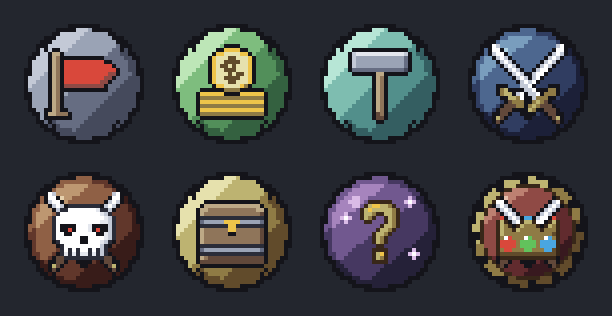
Those icons are the Run Bar: Hearts, gold, the Satchel where Items will live, and the Deckbox, with the star that marks your active deck. Losing a fight costs a Heart, and so does a draw.
A map to walk
Each Stage has a map, a grid ten rows tall and nine columns wide. The bottom and top are always the same: a start, then a Store and a Workshop, and at the far end another Workshop and Store before the Boss. The six rows between are generated.
The generator rolls a map in passes and then checks the whole thing against its rules, like every path having between two and four fights. If the map fails, it gets thrown away and rolled again. My first idea was to roll freely and then repair whatever was wrong, and I dropped it, because a repair is hard to prove will ever finish and every fix quietly bends the odds toward whatever the repair prefers. Rerolling keeps the percentages honest. Over 2,000 seeds every one produced a valid map, in 8.7 attempts on average and 53 at worst, at about a millisecond an attempt. I cut the most fights on a path from five to four during review, which more than doubled the attempts and was still nowhere near mattering.
All of it comes from the Run Seed. The map, the Boss, which Villain a node gives you, and even where each icon sits inside its cell each draw from a stream of their own, so adding a new kind of random choice later can’t reshuffle the old ones. Every attempt at a fight gets a fresh seed too, so a Boss rematch is a new game and not a replay of the one you lost.

On screen you only see your own row and the two ahead, and the view glides up as you go. You are your portrait, the wizard for now, rocking gently on whatever node you’re standing on. The nodes you can reach glow, the links you can take are lit as rows of square dots, and the path you’ve walked turns gold behind you. The Boss waits at the top on a larger clay disc inside a red ring, breathing. That’s the demon, who is currently every Villain in the game.
Fights are the only stops that do anything so far. Stores, Workshops, Troves and Chaos nodes are walked through. There are five placeholder Stages, one per color, built from the three decks that exist. And every debug run hands you an Emblem called Playtest Bolt, which deals 20 damage to any target for no mana, so the end of a run can be tested without having to earn it.
One look for everything
With three screens to draw, the styling stopped being decided one button at a time. The recurring surface is something I’m calling Dither Shading: a rough gradient from a lighter tone at the top to a darker one at the bottom, in five bands of chunky blocks that are dithered where they meet. It’s painted for each surface’s own height, so the blocks never stretch. Panels, rows and buttons all use it now.
The card inspector got the same treatment. The one in an encounter and the one in the Deckbuilder are now built from the same parts, each in its own colors, slate for the battlefield and dark maroon for the workbench. A layout change to one is a change to both.
Pulling the Encounter Screen apart
The Encounter Screen had grown into the file where everything lived, so two pieces moved out. The Hero’s hand is now a Hand Strip, and cards in the air belong to a Flight Layer. The screen tells each what to show, and each reports back what happened without knowing anything about the rest. The payoff is in the tests. The hand’s behavior used to need a whole encounter running to check, and now it’s driven from a hand-built description with no engine at all.
An old annoyance got fixed along the way. A hand of seven or more cards used to jump around under the cursor as it fanned open. In a hand of eight, moving the mouse one pixel could move a card 70 pixels. It’s 3 now.
The Villain got one more lesson as well. With the sample Emblems on, it holds an effect that deals it 2 damage whenever it plays a land, and on Hard it played a land at 1 life and died. Land plays had been automatic and never went through the search. Now Normal and Hard weigh a land that looks costly against holding it for the turn.
Where it stands
There are 37 decision records and around 2,370 test functions, and the roadmap now runs out to milestone 31. The card pool is still 44 cards, since none of this needed a new one.
A debug run goes from the Deckbox to a Stage, across the map, and ends when you beat the Boss or lose your third Heart. What it doesn’t do is pay you. Next up is Spoils, the gold and cards you win from a Villain’s own deck, and after that five Stages in a row so a run is the full length. Then saving, choosing your Hero, and making the Stores and Workshops into places instead of scenery.