Multi-Task King started life as a physical card game called Attentionality. The idea is this: you have one day, you have a limited amount of attention, and you are trying to wring as much enjoyment out of that day as you possibly can. The trouble is that the things most worth doing cost the most attention, and the cheap hits that cost almost nothing are worth almost nothing.
Two values per activity
Every activity in the game carries a duration and a dopamine value. Duration represents how much attention an activity takes to choose, and dopamine is what you score for choosing it. That’s pretty much the whole economy. You start the game with a mere five attention, with a cap of ten, which means a day is a short budget and you are constantly deciding whether to spend it on one big thing or four less impactful ones.
If every card were just those two numbers, the game would be simple arithmetic. So most cards do something in addition to their raw stats.
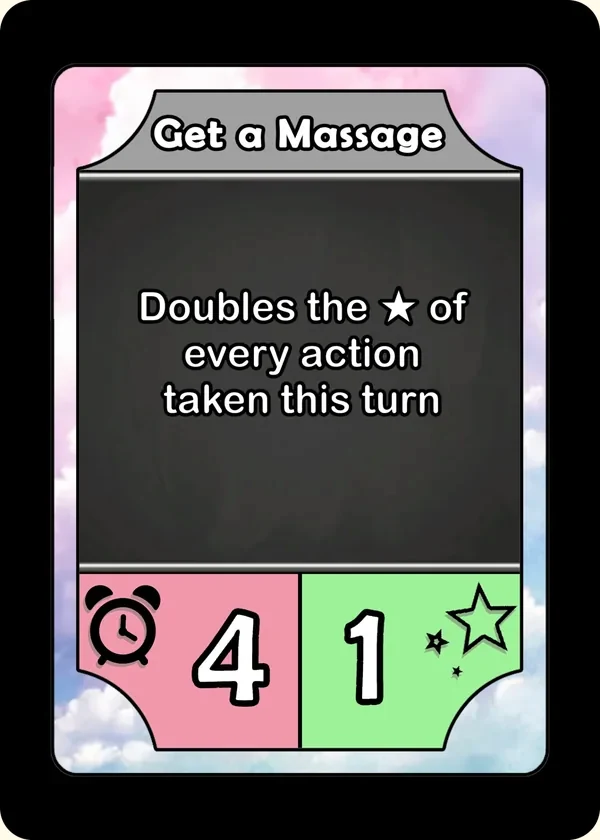
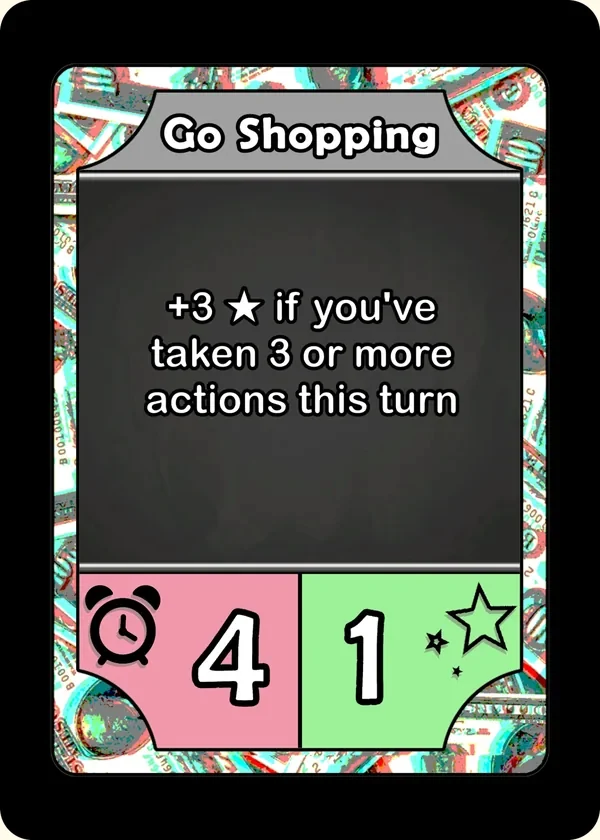
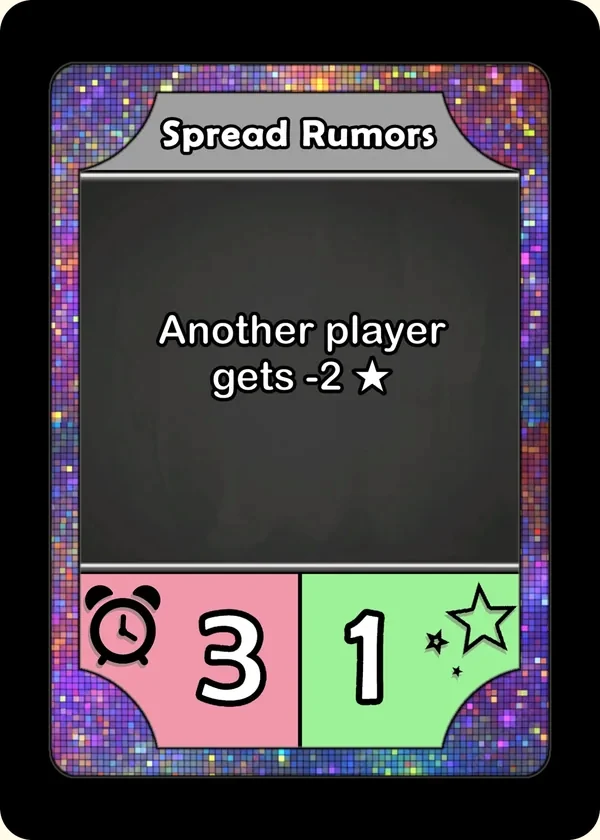
Those three are representative of the kinds of cards in the deck. Get a Massage is a multiplier, worth almost nothing by itself and enormous if you build a turn around it. Go Shopping pays off only if you have already been busy, which rewards a plan you committed to several decisions ago. Spread Rumors does nothing for your own score and takes points off somebody else, which exists because a game where everyone optimizes in parallel is not really a game.
There are a few other shapes in there. Effect cards can augment your attention at the end of the day instead of paying in points, so Eat Fast Food is cheap and immediate but leaves you with less ability tomorrow, and Meditate does the opposite, granting tons of attention at the cost of a lackluster turn. Gifting cards like Cook a Meal hand something to the next player, which matters more than it seems it should.
Roles pull you in a direction
At setup, each player picks a role out of three options, and the role usually pays a bonus whenever you do either of two specific activities.
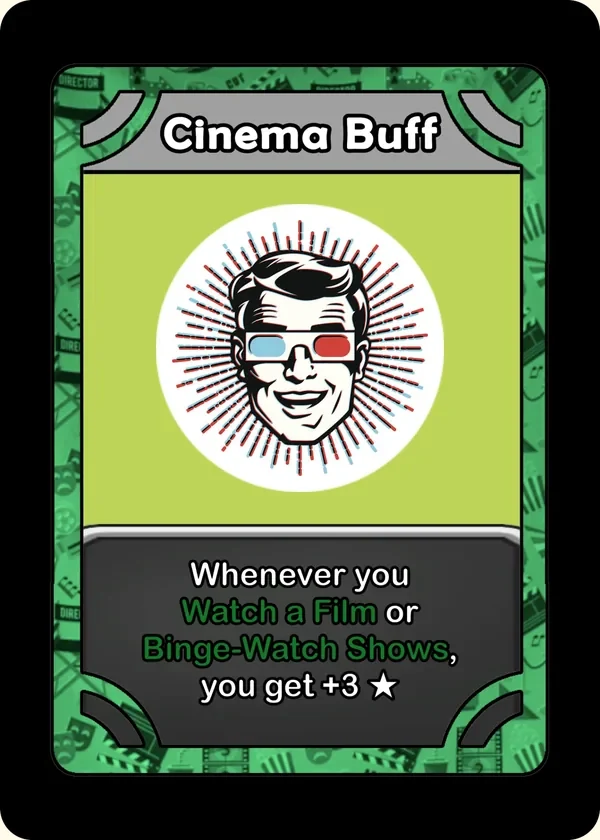
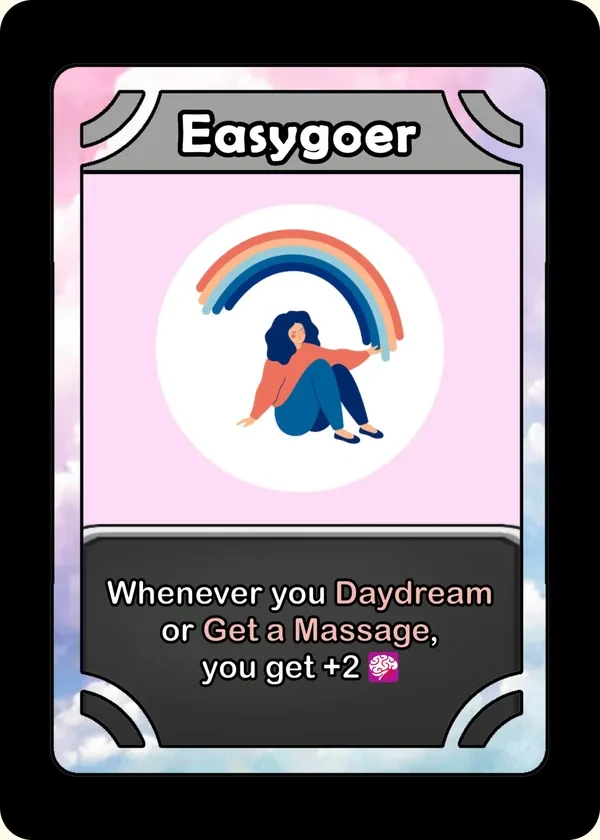
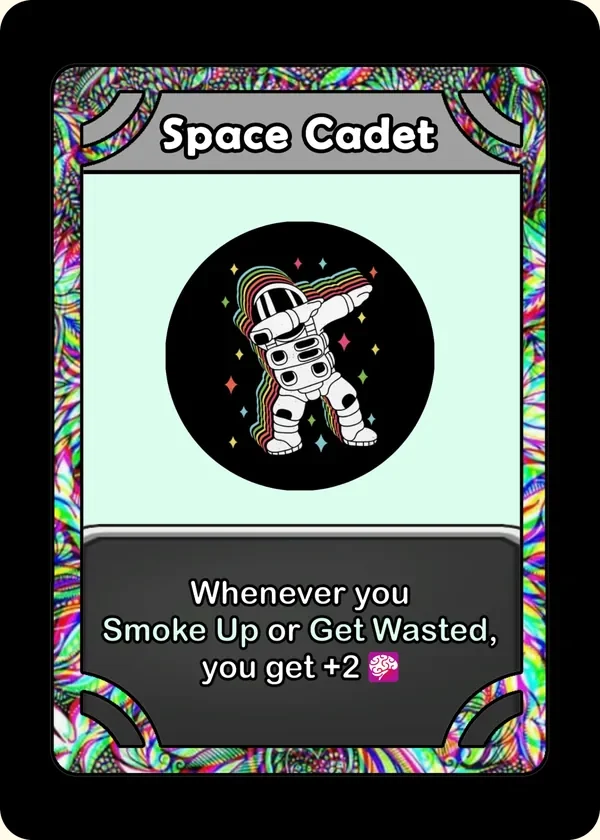
The two activities on a role are always thematically linked, which makes the card easy to read and gives you an identity at the table. Cinema Buff wants screen time and gets paid in points for it. Easygoer and Space Cadet both get paid in attention instead, which is a different kind of bonus: it doesn’t score anything directly, instead allowing for more explosive plays in the future.
The important part is that your role is a suggestion, not a plan. Only six activity cards are face up at a time, so the thing your role loves may simply not be on the table, and you have to decide whether to wait for it or take what is there.
The penalty deck
At the end of each day, one penalty card is drawn and it applies to everybody. Each one punishes a specific activity after the fact, so Brainrot docks you for every time you scrolled shorts that day, Ragebait does the same for checking socials, and One-Star does it for films. A couple of them target behavior rather than a specific card, with Burnout hitting anyone who took two or more actions and Ennui hitting anyone who took one or fewer.
The penalty deck is one of the things that prevents the game from being solvable. You cannot plan around it, because you find out after you have already chosen the day’s activities, and you are stuck weighing whether a third helping of the activity you are good at is worth the risk.
Originally, this was the single most over-tuned part of the game. The first version hit hard enough that a bad draw could completely nullify a good day, and I got some pretty negative feedback about it. Knocking a couple of points off every penalty kept the tension without making luck of the draw feel like the whole game.
What playtesting actually changed
The biggest and most recurring problem of the game was catching up to a runaway leader. Usually whoever got ahead early tended to stay ahead, due to a lack of meaningful catch-up mechanics. The fix was bandwagoning: if you take an action somebody already took this turn, you get a point for it and the person who went first gets two, with more for each additional player who piles on. It gives the trailing players a cheap way to stay close while making the leader’s choices public information worth copying, and it quietly turned a solitaire scoring race into something you could strategize with each other during.
A smaller fix that was in the same spirit: a player sitting at four or fewer attention can “sleep through the day”, skipping their turn to get a whopping three attention back. Before that, running yourself dry almost always meant a dead turn or two.
Playtesters also wanted the game to last longer and the deck to be less bland. Rounds went from eight to ten, and the proportion of vanilla cards, the ones with no text in the middle, came down in favor of cards that do something. One note I liked was the request for a clearer split between devious and wholesome ways of getting your dopamine, since Smoke Up and Call the Cops ought to feel different from Hit the Gym and Cook a Meal even when the numbers are comparable.
What the port changed
Building the Godot version surfaced a different category of problem, which is that some cards were written in a way a person could follow but a computer could not, and a few of those turned out to be confusing for people too.
Daydream originally gave you a point for every other one-point action you took. That is a rule that makes you check the value of each card, apply the bonus, and then wonder whether the bonus changed the value. I rewrote it to key off duration instead of dopamine, which is a number that never moves. Get a Massage got a similar treatment, going from doubling some of your actions to doubling all of them, with its own base value dropped to one so the card stayed in line.
Drink Coffee is my favorite of these. It used to be an effect card that gave you attention back at the end of the day. Now it just costs two less duration. Those are the same thing from the player’s side, and the second version needs no explanation and no end of day bookkeeping.
A couple of changes were purely about overlap. Gamble Online and Eat Fast Food had drifted into being the same card with different art, so Gamble Online moved up in both cost and payoff to occupy a different slot. Drink Coffee went from two copies in the deck to four once it was clear how often you want it.
Where it stands
The digital version isn’t quite a full game right now, due to me still needing to implement ‘attack’ activities among other things. However, there are computer opponents included, and you can customize the deck before you start. You could download the raw files from the GitHub repo, or the executable from the project page. What is left is mostly balance, which is the part that never really ends as it’s beholden to my current design philosophy.