When I last wrote, a run was a walk across a generated map of placeholder Stages, fighting the same purple demon piloting one of three test decks, for no reward. Every piece of the loop existed and none of it had any character.
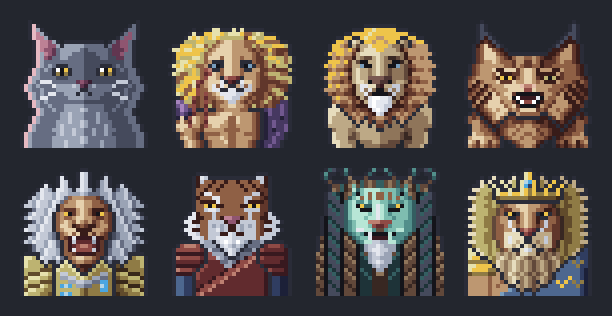
Five days and 28 commits later there’s a place called Kitty Keep, and the eight cats above live there. The work fell into five chunks:
A Stage that’s somewhere
Kitty Keep is white’s first Stage, and the first one that isn’t a slate rectangle. Each Stage can now have a Map Backdrop, one tall pixel art picture as wide as the screen and as tall as the whole map. It scrolls with the map as you climb, so the nodes sit on its ground. Kitty Keep’s is a meadow with a castle and open sky.
Scattered over that is Scenery. A Stage lists the kinds it has and how many of each, and the map places them at random from the Run Seed, so the trees, flower bushes and hay bales land somewhere new each run. They’re kept on a mask painted over the meadow, which leaves out the castle and the sky, and they keep clear of every node, every link and each other. A spot that breaks a rule is thrown away and rolled again, the same way the map itself is. Some of the Scenery is animated, which in Kitty Keep means ginger, gray and black cats sitting around in the grass.
Villains with faces
The demon is retired from Kitty Keep. A Villain’s portrait is now drawn by hand at 32 by 32 pixels, after the art of a real Magic card’s first printing, turned to face the front. The Stage has three Lesser Villains, starting with Charmed Stray, the gray cat at the top left. Steppe Lynx and Kemba are among its Elites, and the Boss can be Zar Ojanen, Arahbo or Brimaz, picked when you enter. Each has a deck of its own.
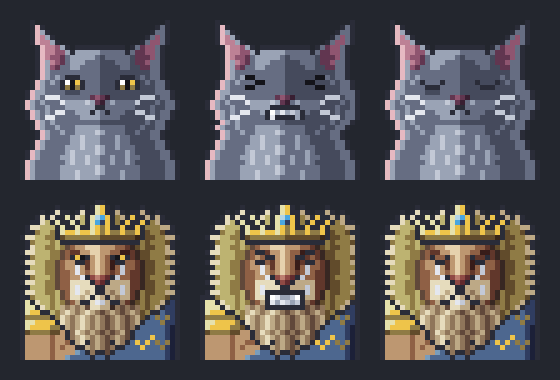
Every portrait comes in three pictures. Next to the normal one there’s a Pain Portrait, the same character the moment after being hurt, wincing and knocked a little aside, and a Blink Portrait with the eyes closed and nothing else changed. The plan is for the pain one to show longer the more life was lost, and for the blink to flicker by every few seconds so the character seems alive. The game doesn’t show either yet. They’re drawn now so that every Villain arrives with all three.

There’s a second flock already drawn, for a Stage of birds that has portraits and no decks yet. That’s the Goose Mother on the left.
44 cards to 121
A Stage of cat Villains needs cat decks, and the card pool was 44 cards of mostly Alpha. So cards now have a track of their own, outside the milestones. A card starts from its current Oracle data, and gets sorted into one of four piles. Ready means the engine can already express it. Blocked means it needs a new primitive. Set Aside means it needs something new on screen, which starts with a prototype. Unsuited means it could never mean anything in this game. Ready cards go in, at most 20 a session, and the rest wait in a file grouped by what they’re waiting on.
The original rule still holds, that a mechanic only enters the game with the first card that needs it. It just gets exercised a lot more often now. The pool is at 121 cards from 45 sets, and getting there added Equipment, +1/+1 counters, lifelink, tokens, modal spells, flashback, the legend rule, library searches, cycling, ward, Auras, X costs and surveil, each one built test-first for a specific card. Oblivion Ring brought exile that undoes itself, and a way to draw it, with the exiled card tucked behind the Ring showing only its name. Brimaz alone needed four new pieces, since he makes a token that enters attacking when he attacks and one that enters blocking when he blocks.
Winning pays
Beating a Villain now opens a Spoils screen. You get gold, and one to three cards drawn from the Villain’s own deck, with better odds of more at higher Ranks. Every nonland copy in the deck is one even ticket, so there’s no rarity weighting. The decks are the tuning, and a tougher Villain pays better because its deck is built richer. You take everything. There’s no pick-one-of-three and no skip, since won cards go to your Collection and not your deck, and what you don’t want can be sold once Stores work. A loss or a draw pays nothing.
Mods got a real definition before anything hands them out. A Mod has a rarity, an Augmentation, which is what it does to the card, and a Mod Cost, which is what it adds to the card’s mana cost. Its text is generated the way rules text is: “Modified card gets +1/+1 and gains trample. It costs 1 more to cast.” Names got rules too. A card’s Mods are named in alphabetical order so the name doesn’t depend on the order you applied them, and the same Mod twice becomes Very. A Plains with Ancient once and Violent twice is an Ancient Very Violent Plains. Three times is Extremely.
Sharper tools
The whole interface got a theme overhaul, and the main menu now has a pixel soldier standing on its window, with a little wisp of light floating around him. The Info Panel in an encounter was rebuilt after it turned into the place where every yes-or-no question gets asked, like whether to pay a ward cost or how much to pay for X.
The test runner got stricter. Godot had been reporting 687 leaked objects at exit, and they turned out to be the test framework’s own, kept alive by an engine fault that one specific class of mine happened to trigger. That’s fixed, and a test run now fails if anything leaks at all. The suite also runs across several threads now.
Where it stands
There are 121 cards, 69 decision records and around 3,790 test functions, up from 2,370 five days ago. Kitty Keep is the only Stage with art, Villains and decks of its own. The other four colors are still placeholders.
Next is making a run its full length, five Stages of rising Tier in five different colors, with proper screens for winning and losing. After that come a reveal screen before each fight, Armor, and the Store and Satchel, so gold has somewhere to go. Then the other four colors need their own Kitty Keeps.